
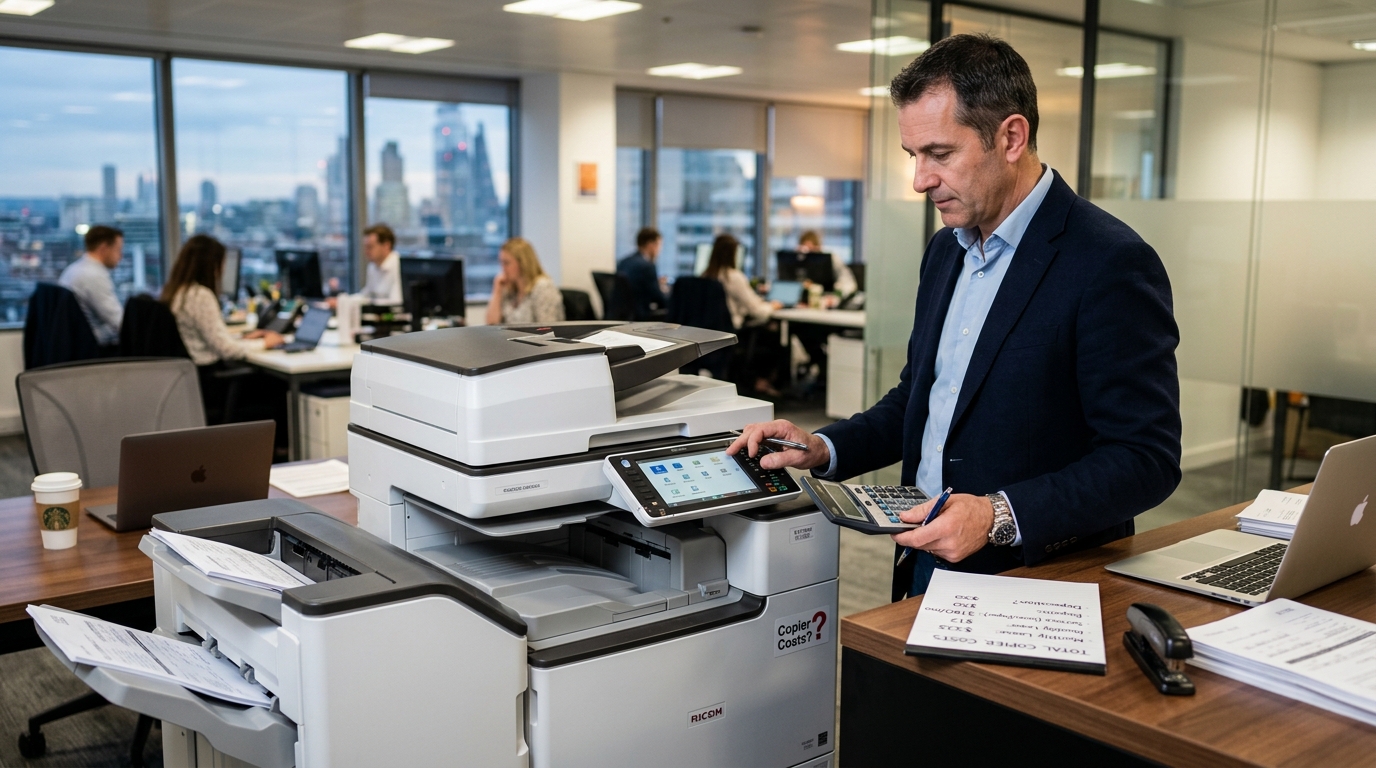
When businesses begin shopping for a business copier, the first number they often look at is the equipment price. But the actual cost of running a copier can extend far beyond the purchase price or monthly payment. Toner, service, maintenance, repairs, supplies, usage, and even employee downtime can affect your total cost.
That’s why two copiers with similar purchase prices can have very different operating costs.
Before choosing equipment, it helps to understand the expenses that can come with a copier throughout its useful life.
The Equipment Is Only the Beginning
A copier is a long-term business tool.
Whether you buy, finance, or lease it, there are ongoing costs associated with keeping the machine operational.
These can include:
- Equipment payments
- Toner
- Maintenance
- Service
- Parts
- Repairs
- Paper
- Meter charges
- Additional usage
- Finishing supplies
The exact costs vary by machine, usage, agreement, and business environment.
This is why it’s important to look at the complete picture.
Purchase Price
If you’re buying a copier outright, the equipment price is an obvious expense.
But don’t automatically assume that the cheapest machine is the least expensive option.
A lower-priced copier may have lower capacity or fewer features.
If your employees quickly outgrow the equipment, you could end up replacing it sooner than expected.
Instead, match the machine to your actual workload.
Copier Lease Payments
Businesses that don’t want to purchase equipment outright may consider a copier lease.
A lease can spread equipment costs over a longer period.
The monthly payment may be easier to incorporate into a predictable operating budget, depending on the agreement.
However, businesses should evaluate the entire lease rather than focusing only on the monthly payment.
Understand the lease term, purchase options, service arrangements, usage charges, and end-of-term provisions.
Toner Costs
Toner is one of the recurring expenses associated with office printing.
Your actual toner usage depends on how much you print, whether you print in color, the coverage of your documents, and the equipment you use.
A business that prints thousands of pages each month can go through significantly more toner than a small office.
When comparing machines, ask about expected toner yields and the cost of replacement supplies.
Service and Maintenance
Every copier eventually needs maintenance.
Routine service can include cleaning, inspections, adjustments, and replacement of worn components.
Maintenance is important because a neglected machine can become less reliable over time.
Depending on your agreement, some service and maintenance costs may be included in a service contract.
Always confirm what is covered.
Repairs
Unexpected repairs can affect your budget.
A copier is a mechanical and electronic device with moving components.
Parts can wear out.
Rollers may need replacement.
Other components can eventually fail.
The older a machine becomes, the more important it may be to evaluate whether continued repairs are financially sensible.
Cost Per Page
Cost per page can be useful when comparing copier options.
However, you need to understand exactly what is included in the calculation.
Depending on the agreement, it may account for some combination of toner, service, parts, and usage.
Ask your copier provider to explain how the cost-per-page calculation works.
This can help you compare different equipment options more accurately.
Color Can Change Your Costs
Color printing can be more expensive than black-and-white printing.
If your office produces a large volume of color documents, pay close attention to color usage.
You may want to establish printing policies that encourage employees to use color when it adds value rather than automatically selecting it for every document.
For example, internal drafts and routine documents may not need color.
Customer-facing presentations and marketing materials may benefit from it.
Paper Is Still an Expense
Paper may seem inexpensive compared with the copier itself, but high-volume printing can make it a meaningful operating expense.
Businesses can reduce unnecessary paper consumption through:
- Duplex printing
- Digital document workflows
- Scan-to-email
- Electronic approvals
- Digital storage
- Print policies
Reducing unnecessary printing can lower both paper and toner usage.
Employee Productivity Has a Cost
One of the least obvious copier expenses is downtime.
Imagine ten employees depend on one copier.
If that copier stops working, all ten employees may be affected.
They may have to walk to another department, wait for service, or postpone document-related tasks.
Even if the repair itself is covered, the productivity loss can still affect your business.
This is one reason reliability matters when comparing equipment.
Security Can Also Affect the Cost
Modern businesses need to think about information security.
If your copier connects to your network or processes confidential documents, security features can be important.
Investing in appropriate security controls can help reduce the risk associated with unauthorized access or improper document handling.
Talk with your IT team about your organization’s requirements.
Different Copier Brands Have Different Models
Businesses can evaluate equipment from Xerox, Kyocera, Sharp, Ricoh, Copystar, and Canon.
Each manufacturer offers different models with different configurations and operating characteristics.
Instead of asking which brand is cheapest, compare specific equipment based on:
- Expected volume
- Print speed
- Color requirements
- Scanning
- Toner
- Service
- Security
- Finishing
- Total operating costs
The model and agreement can matter more than the manufacturer’s name.
How to Estimate Your Total Copier Cost
Start by determining how much your business prints each month.
Then estimate:
Equipment + toner + service + maintenance + supplies + usage + repairs = overall copier expense
For a lease, include the total payments and applicable end-of-term costs.
For a purchase, consider the equipment price and expected service life.
Also consider employee downtime.
You may not be able to assign an exact dollar amount to every factor, but identifying the categories gives you a more complete picture.
Is a More Expensive Copier Ever Cheaper?
Yes, depending on the situation.
A higher-priced copier may offer greater capacity, lower operating costs, faster performance, or features that reduce manual work.
For a high-volume office, investing in equipment that is properly sized can be more economical than purchasing a cheap machine that constantly struggles with the workload.
The key is matching the equipment to the business.
Final Thoughts
The cost of a business copier is more than its sticker price.
Before making a decision, look at the entire lifecycle of the equipment.
Consider the purchase or lease cost, toner, maintenance, service, repairs, paper, usage, and employee productivity.
Then compare those expenses against your expected print volume and business needs.
Printer Copier Guys can help businesses in Riverside and San Bernardino counties evaluate copier equipment, leasing, rental, service, and maintenance options.
Want to understand the total cost of your next business copier? Contact Printer Copier Guys to discuss your requirements.