
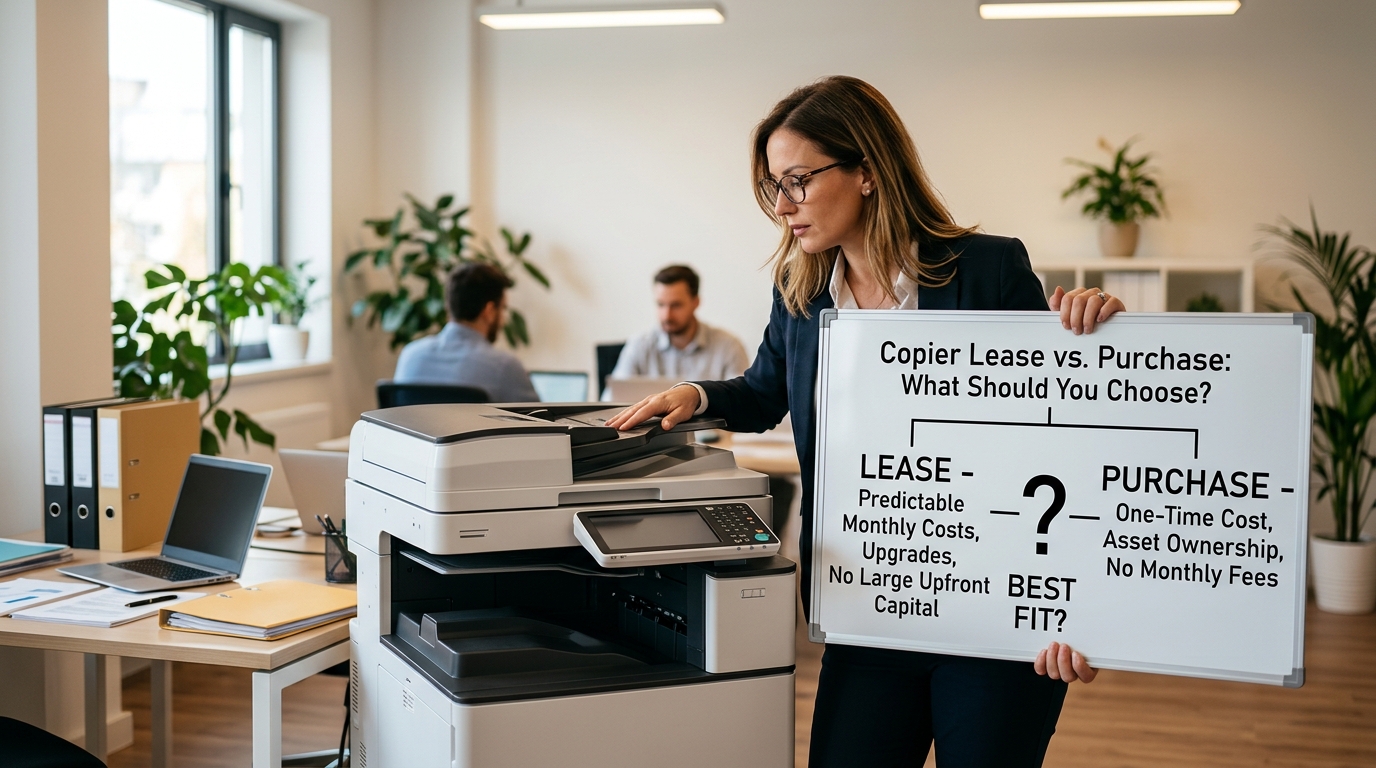
When a business needs new office equipment, one of the first questions is whether to buy it outright or enter into a copier lease. Both options can provide access to the equipment your employees need, but they work differently from a financial and operational perspective.
There isn’t one answer that fits every business.
A small office with predictable printing needs may approach the decision differently from a growing company that wants to preserve cash and regularly update its equipment.
Before making a decision, it’s important to understand how purchasing and leasing compare.
What Does Buying a Copier Mean?
Purchasing a copier means your business pays for the equipment and becomes the owner.
The payment may be made upfront or through financing, depending on the arrangement.
Ownership can provide a straightforward relationship with the equipment. Once you’ve purchased the machine, it belongs to your company, subject to any financing terms.
However, ownership also means your business is responsible for the equipment’s long-term value and maintenance requirements.
As the copier ages, you may eventually need to decide whether to keep repairing it or replace it.
What Is a Copier Lease?
A copier lease allows a business to use equipment over an agreed-upon period in exchange for scheduled payments.
Depending on the agreement, there may be different end-of-term options.
Leasing is commonly considered by businesses that want access to professional equipment while spreading the equipment cost over time.
A lease can also make it easier for businesses to budget for equipment without making a large upfront purchase.
However, businesses should always review the agreement carefully before signing.
Compare the Upfront Cost
One of the most obvious differences between purchasing and leasing is the initial financial commitment.
Buying a copier outright can require a significant upfront investment.
Leasing may require less upfront capital, depending on the agreement.
For businesses that want to keep cash available for hiring, expansion, inventory, marketing, or other priorities, spreading equipment costs over time may be attractive.
However, the monthly payment shouldn’t be the only number you consider.
Look at the total cost of the arrangement.
Consider Your Long-Term Costs
A copier’s cost doesn’t stop at the equipment.
Businesses should consider:
- Toner
- Maintenance
- Repairs
- Replacement parts
- Service
- Supplies
- Meter charges
- Additional usage
- End-of-term costs
A copier that looks affordable based on its monthly payment could have additional expenses that change the overall calculation.
Ask for a clear explanation of what is included in your agreement.
Ownership Can Offer Long-Term Flexibility
One potential benefit of buying is ownership.
Once the equipment is paid for, the business owns the machine.
That can provide flexibility for businesses that intend to keep the equipment for a long time.
However, ownership also means accepting the risk that the equipment will eventually become outdated or require expensive repairs.
Technology changes.
Your business may also change.
A copier that fits your needs today may not be the right machine several years from now.
Leasing Can Provide Access to Newer Equipment
Businesses that prefer regularly updated equipment may consider leasing.
Instead of making a large investment in one machine and keeping it indefinitely, a company can evaluate newer equipment as its lease cycle changes.
This can be particularly relevant for businesses that want modern scanning, security, connectivity, and workflow features.
Of course, the specific options depend on the agreement.
Make sure you understand what happens when the lease ends.
What Happens at the End of a Lease?
This is an important question that shouldn’t be overlooked.
Lease agreements can have different structures and end-of-term provisions.
Depending on the agreement, options may include returning the equipment, purchasing it, or entering into another arrangement.
Read the contract carefully and ask questions about:
- End-of-term requirements
- Purchase options
- Return conditions
- Equipment removal
- Renewal provisions
- Final payments
Understanding these details before signing can help avoid surprises later.
How Much Do You Print?
Your print volume should influence the equipment decision.
A business printing 2,000 pages a month may have very different equipment needs than a company printing 50,000 pages.
Estimate your monthly volume and determine whether it is increasing.
Also consider how much of your printing is color versus black and white.
Your copier provider can use this information to recommend equipment that is appropriately sized for your office.
Think About Your Business Growth
Business growth can make a significant difference.
If you’re hiring employees, adding departments, or opening another location, your printing needs may increase.
Buying a copier that is barely adequate today could leave you with equipment that becomes insufficient sooner than expected.
When evaluating equipment, consider where your business is headed.
Don’t Ignore Service and Maintenance
Whether you buy or lease, your copier needs maintenance.
Ask your provider what service options are available.
Questions to ask include:
- Is routine maintenance included?
- Are parts covered?
- Is labor included?
- What happens when the machine breaks?
- How quickly can a technician respond?
- Is toner included?
- Are remote support services available?
The equipment itself is only one part of the overall copier solution.
Which Brands Should You Consider?
Businesses can evaluate equipment from a variety of manufacturers, including Xerox, Kyocera, Sharp, Ricoh, Copystar, and Canon.
Instead of choosing a manufacturer based only on reputation, compare specific models against your needs.
Consider:
- Print speed
- Recommended monthly volume
- Scanning
- Color capabilities
- Security
- Finishing
- Connectivity
- Operating costs
The right model is the one that fits your workflow.
When Might Buying Make Sense?
Purchasing may be worth considering when your business:
- Has available capital
- Wants to own the equipment
- Expects to keep the copier for a long time
- Has predictable printing requirements
- Is comfortable managing long-term equipment ownership
These factors can make ownership attractive for certain organizations.
When Might Leasing Make Sense?
Leasing may be worth evaluating when your business:
- Wants to preserve upfront cash
- Prefers predictable equipment payments
- Wants access to newer technology
- Expects its equipment needs to evolve
- Wants a structured equipment replacement cycle
Again, the specific lease terms matter.
Compare More Than Two Numbers
When evaluating a copier purchase versus a lease, don’t compare only the purchase price against the monthly payment.
Instead, create a complete cost picture.
For a purchase, consider the equipment price, financing, service, toner, repairs, and expected lifespan.
For a lease, consider the total lease payments, service, toner, meter charges, additional usage, and end-of-term provisions.
This gives you a much more realistic comparison.
Final Thoughts
Choosing between buying and a copier lease is ultimately a business decision.
Consider your cash flow, expected equipment lifespan, print volume, growth plans, technology requirements, service needs, and total costs.
There is no universal solution.
The right approach is the one that aligns with your organization’s financial and operational priorities.
Printer Copier Guys works with businesses in Riverside and San Bernardino counties to help evaluate copier equipment, leasing, rental, maintenance, and service options.
Considering a new copier? Contact Printer Copier Guys to discuss whether leasing or purchasing makes sense for your business.