
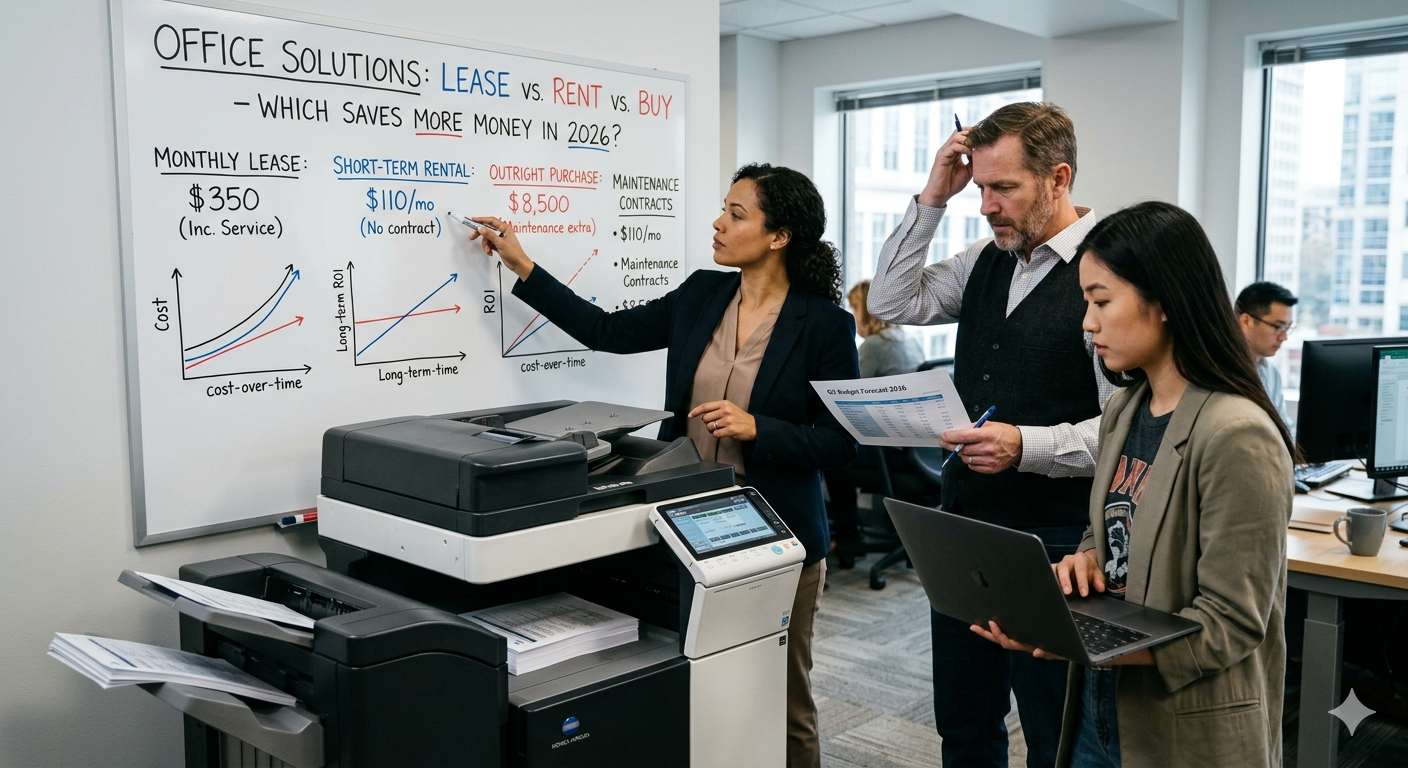
Many businesses choose office equipment based on one thing: the monthly payment.
At first glance, a lower monthly number may seem like the smarter decision. But when copier downtime, repair costs, maintenance, outdated hardware, and long-term operational expenses enter the picture, the “cheapest” option can quickly become the most expensive.
That’s why more companies in 2026 are taking a closer look at the real cost of office printing before committing to equipment.
So what actually saves more money: copier leasing, copier rental, or buying a copier outright?
The answer depends on several factors, including:
- Your business size
- Monthly print volume
- Cash flow
- Growth plans
- Need for flexibility
- Technology requirements
A startup with unpredictable growth will likely need a different solution than a law office with stable monthly printing needs. A temporary project site may benefit from renting, while a long-established company might prefer ownership.
This guide breaks down the real costs, advantages, and drawbacks of each option so your business can make a smarter financial decision in 2026.
Quick Answer — Which Option Saves the Most Money?
For most growing businesses, copier leasing offers the best balance between affordability, flexibility, and predictable costs.
Copier rentals are ideal for short-term needs, while buying a copier can make sense for stable businesses with predictable usage and long equipment lifecycles.
| Option | Best For | Upfront Cost | Flexibility | Long-Term Cost |
|---|---|---|---|---|
| Leasing | Growing businesses | Low | High | Moderate |
| Renting | Temporary needs | Low | Very High | Higher over time |
| Buying | Stable companies | High | Low | Lower long-term if managed well |
The key is understanding your total operational cost — not just the monthly payment.
What Does It Mean to Lease, Rent, or Buy a Copier?
Before comparing costs, it helps to understand how each option works.
Copier Leasing
Copier leasing allows businesses to use equipment through fixed monthly payments over a contract term, usually 36 to 60 months.
Most copier lease agreements include:
- Maintenance
- Service support
- Parts replacement
- Equipment upgrades
- Toner programs in some cases
Leasing is popular because it keeps upfront costs low while giving businesses access to newer technology.
For many companies, leasing functions similarly to a business subscription model for office equipment.
Copier Rental
A copier rental is designed for short-term use.
Rental agreements are commonly used for:
- Temporary offices
- Construction trailers
- Events
- Seasonal operations
- Rapid expansion periods
Rental terms may last days, weeks, or months instead of years.
Renting provides maximum flexibility but often comes with higher monthly costs compared to leasing.
Buying a Copier
Buying means your business owns the copier outright.
This usually involves:
- A large upfront investment
- Responsibility for maintenance
- Paying for repairs after warranty expiration
- Managing upgrades independently
Some companies prefer ownership because it eliminates recurring lease payments. However, ownership also transfers all long-term risks and maintenance costs to the business.
The Real Cost of Leasing a Copier
For many businesses in 2026, copier leasing offers the most practical financial balance.
Why Leasing Has Become More Popular
Office technology changes quickly.
Modern copiers now include:
- Cloud printing
- Workflow automation
- Security features
- Mobile device integration
- Advanced scanning capabilities
Businesses that buy equipment outright may end up stuck with outdated hardware within a few years.
Leasing helps companies stay current without large capital investments.
What Businesses Typically Pay For
Lease agreements generally include:
- Monthly equipment payments
- Maintenance coverage
- Service agreements
- Technical support
- Optional managed print services
This creates more predictable office printing costs, which helps businesses manage cash flow more effectively.
Leasing Helps Preserve Working Capital
One major reason businesses choose printer leasing for businesses is cash flow management.
Instead of spending thousands upfront, companies can spread costs over time and preserve capital for:
- Hiring
- Marketing
- Expansion
- Inventory
- Technology investments
For growing businesses, that flexibility often matters more than ownership.
Example Scenarios
Small Business Example
A small accounting office may need reliable printing but cannot justify spending $8,000 upfront on equipment.
Leasing allows them to:
- Access enterprise-level equipment
- Keep monthly expenses predictable
- Avoid surprise repair bills
Mid-Sized Office Example
A healthcare office printing thousands of pages monthly may benefit from bundled service and maintenance agreements included with leasing.
This reduces downtime and simplifies budgeting.
Fast-Growing Company Example
A rapidly expanding business may outgrow its copier within two years.
Leasing makes upgrades easier without needing to resell outdated equipment.
Potential Tax Advantages
Some lease payments may qualify as deductible operating expenses depending on business structure and tax laws.
Businesses should always consult an accountant regarding specific tax implications.
When Copier Rentals Make More Financial Sense
Renting is often overlooked, but in the right situation, it can actually save businesses money.
Copier Rentals Work Best for Temporary Needs
Businesses commonly choose copier rental solutions for:
- Temporary offices
- Trade shows
- Conferences
- Construction projects
- Seasonal businesses
- Short-term staffing increases
If your business only needs equipment temporarily, renting avoids long-term commitments.
Why Renting Can Save Money
Although rental rates are higher monthly, rentals can still cost less overall if the need is temporary.
For example:
A construction company operating a six-month project site likely benefits more from renting than signing a five-year lease.
Similarly, event organizers may only need high-volume printing equipment for several weeks.
Benefits of Copier Rental
- Fast deployment
- Flexible terms
- No long-term commitment
- Easy equipment scaling
- Maintenance often included
Downsides of Renting
- Higher monthly cost
- Less cost-effective long-term
- Limited customization options
- Fewer upgrade incentives
Renting is usually about flexibility, not long-term savings.
The Hidden Costs of Buying a Copier
Buying a copier seems cheaper on paper because there are no monthly lease payments.
But many businesses underestimate the real ownership costs.
Large Upfront Investment
Commercial copier solutions can cost several thousand dollars upfront.
That money becomes tied up in depreciating equipment instead of being used elsewhere in the business.
Repair Costs Add Up Quickly
Once warranties expire, businesses become responsible for:
- Service calls
- Replacement parts
- Maintenance labor
- Emergency repairs
A major repair on an aging copier can cost far more than expected.
Downtime Can Become Expensive
Older copiers often become less reliable over time.
When equipment fails, businesses may experience:
- Delayed workflows
- Missed deadlines
- Reduced productivity
- Employee frustration
The cost of downtime is often greater than the repair itself.
Technology Becomes Outdated
Office printing technology evolves quickly.
Businesses that buy equipment may struggle with:
- Outdated security features
- Slow printing speeds
- Limited cloud integration
- Compatibility issues
Many companies keep outdated copiers longer than they should simply because they already own them.
Supply Costs Are Often Higher
Businesses that own copiers frequently pay separately for:
- Toner
- Parts
- Service contracts
- Maintenance visits
Lease agreements often bundle these expenses into predictable monthly costs.
Real-World Ownership Problems
Many businesses experience situations like:
- Repair bills exceeding the copier’s value
- Productivity losses from aging hardware
- Expensive replacement parts no longer available
- Inability to scale equipment as business needs grow
Buying can work well for stable organizations, but it is not automatically the cheapest solution.
Lease vs Rent vs Buy — Long-Term Cost Comparison
Here’s a side-by-side comparison of how these options differ financially and operationally.
| Factor | Lease | Rent | Buy |
|---|---|---|---|
| Upfront Cost | Low | Low | High |
| Monthly Expense | Moderate | Higher | None after purchase |
| Maintenance Responsibility | Usually included | Usually included | Business responsibility |
| Upgrade Flexibility | High | Very High | Low |
| Long-Term Commitment | Medium | Low | High ownership commitment |
| Scalability | Easy | Easy | More difficult |
| Downtime Risk | Lower | Lower | Higher over time |
| Technology Refresh | Easy | Easy | Expensive |
| Predictable Expenses | Strong | Moderate | Less predictable |
| Best For | Growing businesses | Temporary needs | Stable long-term usage |
The cheapest option depends entirely on how your business operates.
A company focused on flexibility may save more with leasing, while a highly stable organization with low technology demands may benefit from ownership.
Which Option Is Best for Small Businesses?
Small businesses often prioritize:
- Cash flow
- Flexibility
- Reliability
- Predictable expenses
That’s one reason copier leasing remains highly popular among smaller organizations.
Why Leasing Often Fits Small Businesses Best
Small businesses typically do not have:
- Dedicated IT teams
- Large equipment budgets
- Resources for major repairs
Leasing helps reduce financial surprises.
Common Small Business Scenarios
Startups
Startups benefit from low upfront costs and scalable equipment options.
Small Law Firms
Law offices often need dependable high-volume printing without downtime interruptions.
Medical Offices
Healthcare practices frequently lease because they need updated technology, secure printing, and reliable service support.
For many small businesses, leasing creates the best balance between affordability and operational stability.
Which Option Is Best for Large Businesses?
Larger organizations have different priorities.
These companies often focus on:
- Fleet management
- Workflow efficiency
- Standardization
- Multi-location support
- High print volume optimization
Leasing Combined with Managed Print Services
Many large organizations combine copier leasing with managed print services to improve efficiency and reduce waste.
This approach can help businesses:
- Monitor usage
- Reduce unnecessary printing
- Improve security
- Automate supply replenishment
- Lower overall office printing costs
Why Large Businesses Rarely Buy Everything Outright
Owning large copier fleets creates challenges such as:
- Equipment aging inconsistently
- Large maintenance costs
- Complicated upgrade cycles
- Increased downtime risk
Leasing often simplifies equipment management across multiple locations.
Common Mistakes Businesses Make When Choosing a Copier
Many copier decisions become expensive because businesses focus only on short-term pricing.
Choosing Based Only on Monthly Payment
A low monthly payment may hide:
- High service fees
- Poor maintenance coverage
- Inflexible contracts
Ignoring Maintenance Costs
Maintenance expenses can dramatically increase ownership costs over time.
Underestimating Print Volume
Businesses frequently outgrow their equipment faster than expected.
An undersized copier can create workflow bottlenecks and productivity issues.
Signing Inflexible Contracts
Not all copier financing options provide easy upgrades or scalability.
Businesses should carefully review terms before committing.
Buying Oversized Equipment
Some businesses purchase enterprise-level equipment they never fully use.
This increases both purchase cost and operational expenses.
Failing to Plan for Growth
A copier solution should support future business needs — not just current demand.
How to Decide Which Option Saves Your Business More Money
The right choice depends on your operational goals, growth plans, and financial priorities.
Here are some questions businesses should ask first:
- How long will we need the equipment?
- How quickly are we growing?
- Do we need flexibility?
- Can we handle major upfront costs?
- How important is predictable budgeting?
- How critical is uptime?
Lease If…
- You want predictable monthly expenses
- Your business is growing
- You need technology upgrades
- You want maintenance included
- Cash flow flexibility matters
Rent If…
- Your need is temporary
- You need fast deployment
- Flexibility is the top priority
- You want to avoid long contracts
Buy If…
- Your print volume is stable
- You plan to keep equipment long-term
- You can absorb repair costs
- Technology changes are less important to your operation
The lowest upfront cost is not always the best long-term financial decision.
Final Thoughts
When comparing copier leasing, copier rental, and buying, the real question is not simply, “Which costs less today?”
The better question is:
Which option creates the lowest total operational cost over time?
Businesses should evaluate:
- Flexibility
- Maintenance coverage
- Downtime risk
- Upgrade access
- Technology lifecycle
- Long-term office printing costs
For many growing companies in 2026, copier leasing offers the strongest balance between affordability, scalability, and reliability.
But every business operates differently.
A temporary project may benefit from renting, while a stable company with predictable usage could justify ownership.
The key is choosing a solution that supports both your current needs and future growth.
PCG Copiers can help businesses evaluate copier leasing, rental, and ownership options based on print volume, workflow needs, budget, and long-term operational goals.
Frequently Asked Questions
Is leasing a copier cheaper than buying?
Leasing is often cheaper upfront and may reduce maintenance costs, but buying can cost less long-term if the equipment remains reliable for many years.
Are copier rentals tax deductible?
In many cases, copier rental expenses may qualify as deductible business expenses. Businesses should consult a tax professional for guidance.
How long do copier leases usually last?
Most copier lease agreements range from 36 to 60 months depending on the equipment and business needs.
What’s included in a copier lease?
Many leases include maintenance, service support, repairs, and sometimes toner replacement programs.
Is renting better for short-term business needs?
Yes. Copier rentals are often the most cost-effective option for temporary offices, events, construction sites, or seasonal operations.
Can businesses upgrade leased copiers?
Many leasing agreements allow equipment upgrades during or after the lease term, especially if business needs change.
What is the average cost of a business copier?
Business copiers can range from a few thousand dollars to well over $10,000 depending on print speed, features, and production volume.